How do safety systems work in AGVs and AMRs?
Discover safety systems in AGVs and AMRs
How do safety systems work in AGVs and AMRs? Protecting people in hybrid workplaces
Modern production facilities and logistics centers are increasingly adopting hybrid work environments in which mobile robots (AGVs and AMRs) share the workspace with people and traditional forklifts. In such environments, ensuring the highest level of personnel safety is an absolute priority.
How can a several-hundred-kilogram automated vehicle carrying a load reliably react to a pedestrian suddenly entering its path? Collision prevention is ensured by an advanced, multi-layered safety system architecture.
- How warning and protective fields work in certified LiDAR safety scanners
- How safety fields are dynamically adjusted according to the robot’s speed and steering angle
- How 3D cameras and auxiliary sensors eliminate so-called “blind spots”
- How visual and acoustic signals warn employees in the facility
1. Laser safety scanners (LiDAR)
One of the primary safety components used in most automated mobile robots is a certified laser safety scanner (LiDAR). These scanners continuously monitor the surroundings in a horizontal plane and create two key detection zones around the robot:
Warning zone (yellow)
When a person or obstacle is detected within this zone, the robot automatically reduces its speed and activates a warning signal, providing both sides with time to react.
Protective / stop zone (red)
When an obstacle enters this zone, the robot is immediately and safely brought to a complete stop by a dedicated safety controller.
2. Dynamic adjustment of safety fields
Importantly, the size and shape of the safety fields are not fixed. The robot’s safety controller adjusts them in real time according to its operating parameters:
- Driving speed: The faster the vehicle is moving, the farther the protective field extends, taking the required stopping distance into account.
- Steering angle: When maneuvering through turns, the field is asymmetrically adjusted toward the planned direction of travel.
3. Three-dimensional protection: 3D cameras and auxiliary sensors
The main laser scanner typically operates at a fixed height (e.g. 15–20 cm above the floor). To eliminate so-called “blind spots”, modern AMRs and AGVs are equipped with additional sensors that detect objects outside the scanner’s detection plane:
Depth cameras (3D)
They detect objects located below or above the scanner, such as extended forklift forks, suspended cables, or machine components.
Ultrasonic / radar sensors
They help detect obstacles with difficult optical properties, such as transparent stretch film, glass, or very dark, light-absorbing surfaces.
4. Visual and acoustic signaling
Safety also depends on clear and immediate communication with the surrounding environment. Automated mobile robots inform pedestrians of their intended actions using clear visual and audible signals:
- LED lighting / BlueSpot: Projects bright spots or arrows onto the floor in front of and behind the robot, warning employees approaching from behind shelving or other obstacles.
- Turn signals and LED strips: Indicate the planned direction of travel, turning in place, or changing lanes.
- Audible signals: Activated during reversing, maneuvering in confined spaces, or when an obstacle is detected.
5. Standards and certification for RB Poland systems
All AGV and AMR mobile robots designed and delivered by RB Poland are developed in strict compliance with European safety directives and standards, including the key standard EN ISO 3691-4 for driverless industrial trucks.
Every implementation at the customer’s facility is completed with an audit and the delivery of full technical documentation, including the CE Declaration of Conformity.
Summary: 3 pillars of mobile robot safety
1. Active detection
2D LiDAR scanners and 3D depth cameras continuously monitor the space around the robot.
2. Safety speed logic
Dynamic adjustment of stopping zones based on the robot’s speed and trajectory.
3. Human warning
BlueSpot projectors, LED lighting, and audible signals that warn people ahead of the robot’s movement.
Not sure which solution is best for your facility?
You don’t have to make the decision on your own. The RB Poland engineering team will analyze your production processes, route layouts, and load requirements to select the technology that is perfectly suited to your needs.
Check out the articles below or explore the full AGV & AMR GUIDE (FAQ)
Learn the fundamentals of internal transport automation. Discover how mobile robots are replacing traditional transport methods and improving intralogistics in manufacturing facilities.
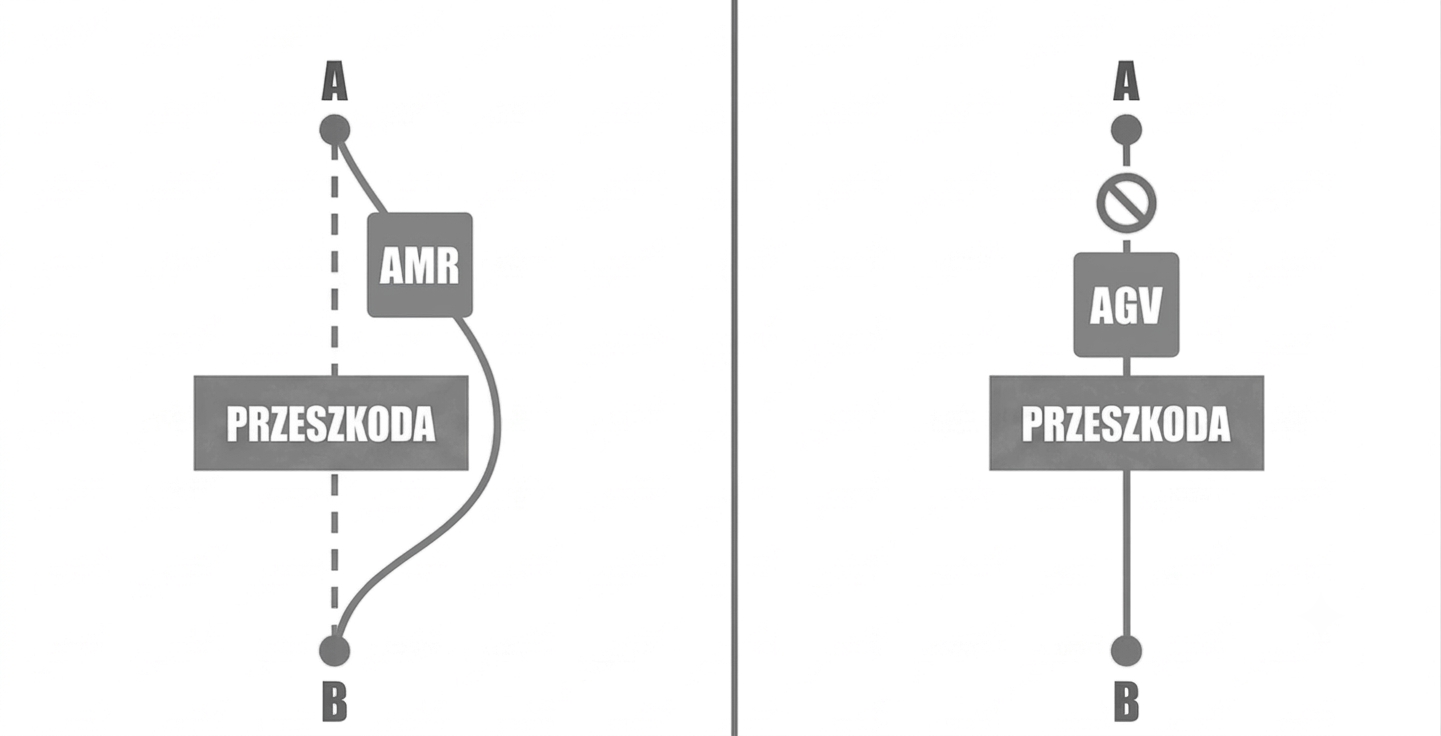
We compare AGVs and AMRs. Find out which solution is better suited to your working environment.
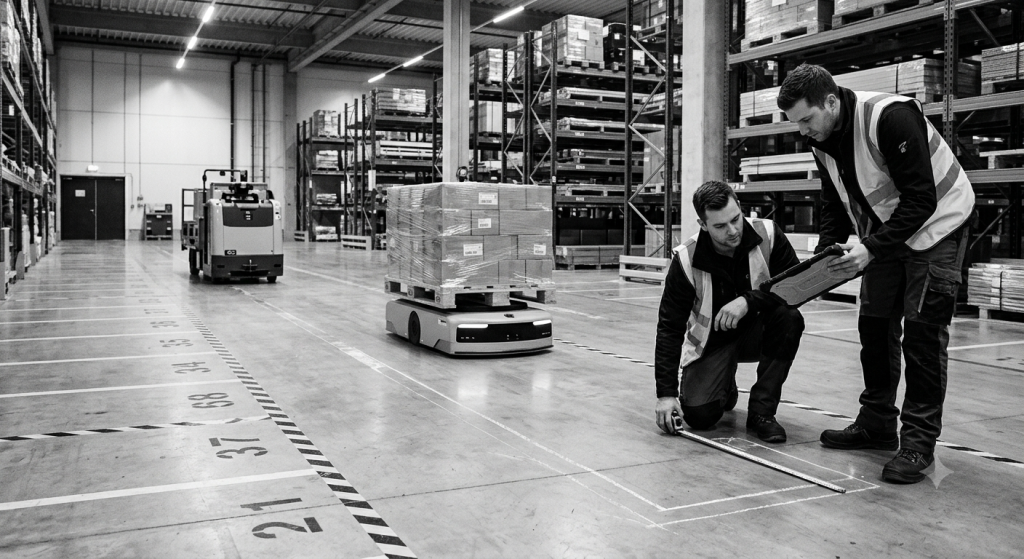
See how little is needed to introduce a fleet of AGVs or AMRs into your factory.